

Throughout history, every civilization produces a small minority of people who seem unusually
sensitive to misalignment.
They notice cracks in systems long before those cracks become visible to everyone else.
Sometimes they are inventors.
Sometimes they are philosophers.
Sometimes they are simply the person in the room quietly asking the question everyone else
would rather avoid.
In my own language, I’ve come to think of them as crack finders.
And when they decide to do something about what they see — when they choose to illuminate
the misalignment rather than quietly ignore it — they become light shiners.
History has used many different names for these people.
Prophets.
Watchmen.
Vision keepers.
Or simply seers.
Different cultures used different words, but the role itself has always been remarkably consistent.
A small minority of people appear able to detect patterns and contradictions long before the rest
of society recognizes them.
And throughout human history, civilizations have depended on those people far more than they
often realize.
Because crack finders tend to feel misalignment long before others do.
They notice inconsistencies others have learned to live with.
They ask inconvenient questions.
They point toward changes that may not yet feel necessary — or safe.
Without them, societies drift quietly toward failure.
But history also reveals another pattern.
Seers are not only valuable to civilizations.
They are often dangerous to existing power structures.
Not because they seek conflict, but because shining light on a crack changes what others can see.
And once enough people see clearly, systems built on denial or inertia begin to wobble.
That is why societies have always had an uneasy relationship with their seers.
Sometimes they are celebrated.
Often they are ignored.
And occasionally they are silenced.
Because unwanted leaders eventually produce unwanted followers.
Civilizations rarely collapse because they lacked warnings.
They collapse because they ignored them.
Which makes one aspect of modern life increasingly difficult to ignore.
We may be living in one of the most information-rich eras in human history.
And yet we often seem remarkably deaf to our seers.
Too busy.
Too certain.
Too invested in the stability of the systems we already have.
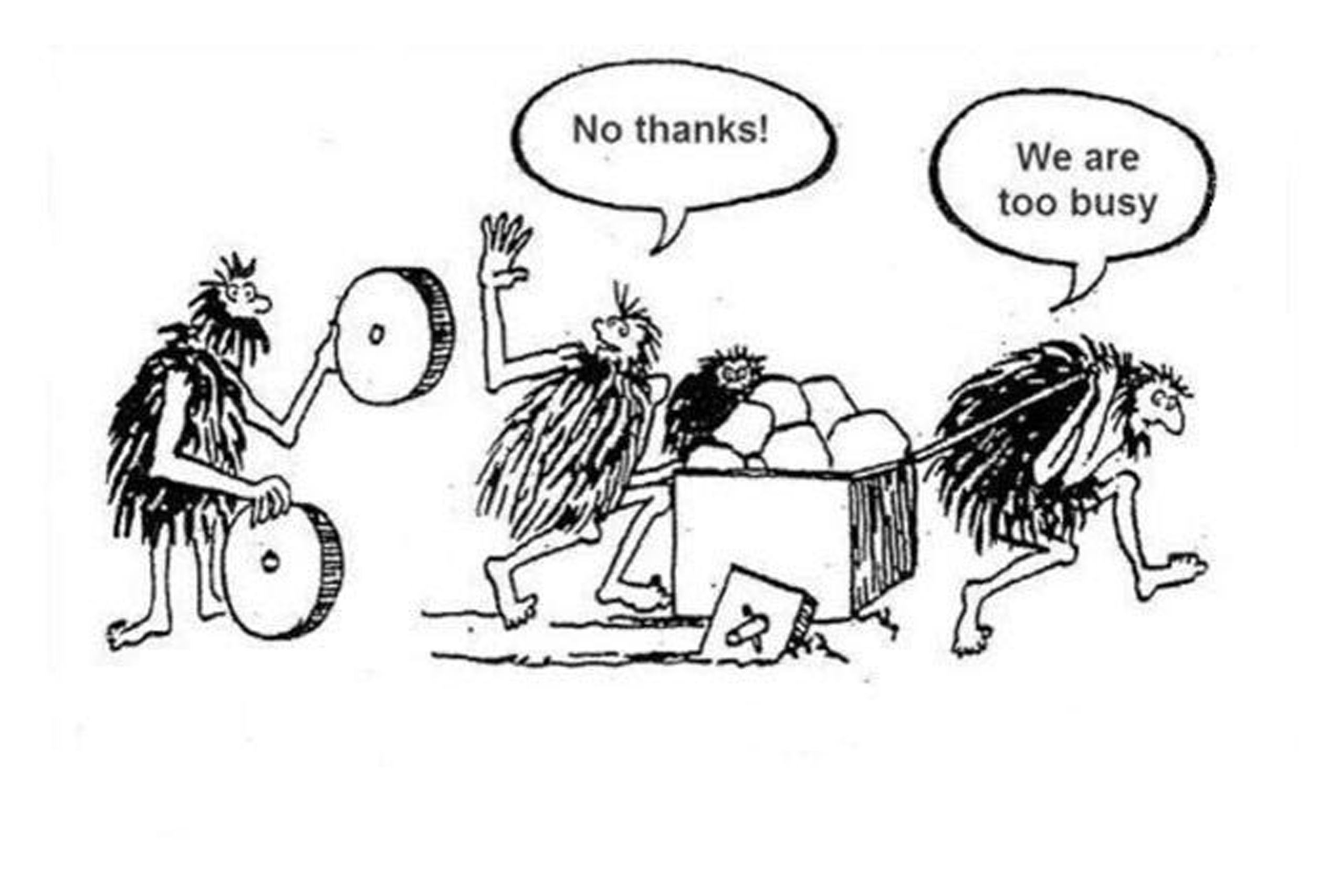
Sometimes the dynamic looks almost absurd.
The humor of this cartoon works because the pattern is so familiar.
The person pointing toward a better way.
The system responding:
“No thanks.”
“We’re too busy.”
Once you start noticing the pattern, it appears everywhere.
Looking back over my own life, I eventually realized that many of the moments that shaped my
thinking began exactly this way.
Seeing a crack.
And deciding — for better or worse — to shine a light on it.
Many people notice cracks.
Very few feel compelled to carry the flashlight.
And once you pick it up, it can be surprisingly difficult to put it down.
A Framework Appears
One of the earliest stepping stones in my own flashlight journey came while I was working
inside a large chemical company early in my career. At the time, there was a significant number
of mergers occurring, our company was no different.
I made a name for myself quickly and was increasingly asked to lead complex projects.
Eventually being asked to form a new role in the company focused on mid-to-long range
innovations and new business development.
Almost immediately I began experiencing the tensions from what I would later learn to be the
frictions caused by underlying differences in how reality is viewed.
Many of the opportunities that seemed obvious to me appeared invisible to others inside the
organization.
Conversations with senior leadership often felt like we were describing entirely different futures.
Fortunately, someone else noticed the tension as well.
A colleague pulled me aside and told me that he saw much of himself in me and knowing what I
was building, recommended I meet two mentors now turned consultants who specialized in
helping companies with new business opportunity identification and development. And they
started exactly where I needed them to — with personality type and temperament assessment.
Their work drew heavily from the ideas of Carl Jung and the framework that later became known
as Myers-Briggs.
We brought them in for a three-day workshop involving both senior leadership and the R&D
organization.
What they showed us was immediately illuminating.
Across many organizations they studied, senior leadership teams often leaned heavily
toward Sensing — focusing on what can be measured, verified, and proven.
Research and development groups, on the other hand, frequently leaned toward Intuition —
people comfortable exploring patterns and possibilities before the data fully exists.
That difference, they claimed, is a common source of friction in the innovation process and
R&D. They told me that this imbalance is common, however in my particular case, it was the
most lopsided they had ever seen!
For the first time, the tension I had been sensing began to look less like personality conflict and
more like something fundamental and structural.
The Epiphany Mowing the Lawn
Not long after that workshop, I found myself thinking about these patterns constantly.
One afternoon in June of 2001, I was mowing my lawn and for reasons I still can’t fully explain,
I had started carrying a mechanical pencil and paper with me while I mowed.
Insights kept appearing while I walked behind the mower — fragments of a pattern I was trying
to understand — but they disappeared before I could hold onto them.
So this time I came prepared.
Every few passes across the yard another thought surfaced and I quickly wrote it down before it
slipped away.
Another pass.
Another fragment.
Another note.
Eventually I stopped and looked down at the page.
There they were — scattered observations written in my own handwriting.
Observable patterns in the process of innovation.
Revelations about the friction between functions.
And the realization that people inside the same system often perceive reality differently.
For the first time I could see how the pieces connected.
My hand was still holding the metal bar that keeps the mower running.
I stared at the page for a moment.
Then I let the bar go.
The engine shut off.
The yard went quiet.
My head began to tingle and I said the words out loud for the first time.
It’s the Ultimate Human Dilemma!!!
Then I wrote the phrase down and circled it, many times.
The Frictions Between the Functions
At first, I thought the phrase described something very specific.
Innovation.
Inside organizations the pattern became easy to see once I knew what to look for.
Leaders would say they wanted new ideas, but the moment those ideas appeared the system often
began quietly resisting them.
Ideas that depended on imagination were asked for proof before the proof could possibly exist.
Processes designed to manage risk filtered out the very possibilities they claimed to seek.
Over time it became clear that the friction wasn’t really about the ideas themselves.
It was about how the people evaluating those ideas perceived the world.
Some minds rely on what can be verified.
Others rely on patterns and possibilities that appear before the data arrives.
That tension — between the minds that must verify the present and the minds that sense the
future — was what I began calling The Ultimate Human Dilemma, or simply the “frictions
between the functions.”
Years later I realized that much of what I had been observing had already been described by Carl
Jung in his theory and 1921 book titled Psychological Types.
And the pattern wasn’t limited to organizations.
Albert Einstein once described the same imbalance in a single sentence:
“The intuitive mind is a sacred gift and the rational mind is a faithful servant.
We have created a society that honors the servant and has forgotten the gift.”
Einstein wasn’t speaking about personality frameworks.
But he was pointing to the same tension.
Civilizations tend to organize themselves around what can be verified.
Processes.
Metrics.
Control.
Those tools create stability.
But they can also make systems remarkably resistant to the people who sense the future before it
can be proven.
The Civilizational Pattern
Once you start looking for seers, you begin to notice something interesting about human history.
Nearly every civilization eventually develops a role for people who perceive misalignment
earlier than others.
The Greeks had oracles.
Hebrew traditions spoke of prophets and watchmen.
Indigenous cultures often recognized vision keepers whose role was to sense when a community
was drifting out of balance.
Different cultures used different language, but the role itself was strikingly consistent.
Equally interesting was how those cultures cultivated the ability to listen.
Long before modern psychology existed, many traditions developed practices that quieted the
body and sharpened perception.
Meditation.
Prayer.
Fasting.
Silence.
Time in nature.
These practices were not originally designed to convince people of a belief.
They were designed to attune the nervous system.
Truth, in those traditions, was something to be felt and embodied, not simply argued.
And when a culture’s nervous system becomes too agitated, distracted, or certain of itself, the
ability to hear those quieter signals begins to fade.
Which raises an uncomfortable possibility for our own time.
We may be the most technologically advanced civilization in human history.
But we may also be one of the most distracted.
The Question That Remains
After thirty years studying personality patterns, I still don’t fully understand why crack finders
exist.
Some aspects of personality clearly run in families.
Traits like extroversion, introversion, sensing, and intuition often appear to have genetic
components.
But every once in a while something unexpected happens.
Two intuitive parents have a sensing child who feels strangely familiar — like a reflection of a
grandparent or someone from another generation.
Patterns appear that don’t fit neatly into genetics alone.
Which raises a deeper question.
If personality is shaped by both biology and environment, what part of us persists beneath those
layers?
Many contemplative traditions describe something called the witness — the quiet awareness that
observes our thoughts, emotions, and experiences.
Personality may shape how that awareness expresses itself in the world.
But the awareness itself may be something deeper.
Carl Jung once wrote that he could not say whether his life was the story of his soul, or whether
his soul was the story of his life.
After decades of watching crack finders appear in every system I’ve studied, I sometimes
wonder the same thing.
The Flashlight
What I do know is this.
Every system eventually produces a few people who notice its cracks earlier than everyone else
— and some of them carry flashlights.
But the system does not truly fear the seer.
It fears the moment others begin to see.
Because unwanted leaders eventually produce unwanted followers.
And once enough people see the cracks clearly, the system can no longer pretend they aren’t
there.
Which may be why the health of any society depends on something surprisingly simple.
Not just protecting the people who notice the cracks.
But learning to listen to them.