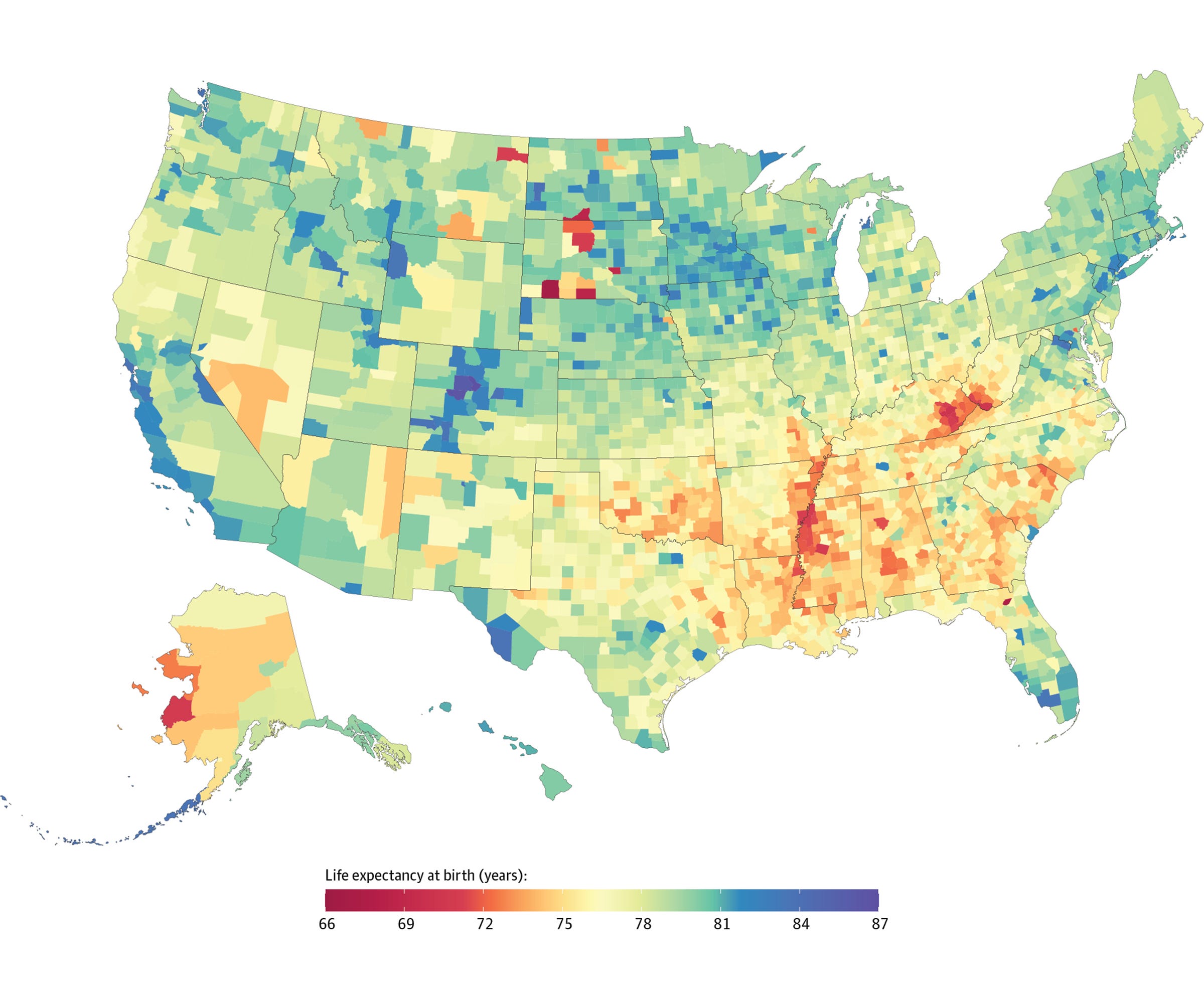


County-level life expectancy data in the United States show something difficult to ignore.
Depending on where you live, average lifespan can differ by nearly 20 years.
In some counties, life expectancy reaches into the mid-80s. In others, it falls into the mid-60s.
Source: Institute for Health Metrics and Evaluation (IHME). U.S. Health Map — County-Level Life Expectancy Estimates (2019).
Source: Institute for Health Metrics and Evaluation (IHME). U.S. Health Map — County-Level Life Expectancy Estimates (2019).
Source: Institute for Health Metrics and Evaluation (IHME). U.S. Health Map — County-Level Life Expectancy Estimates (2019).
Source: Institute for Health Metrics and Evaluation (IHME). U.S. Health Map — County-Level Life Expectancy Estimates (2019).
The map does not argue, nor does it assign blame.
It does not care who we vote for, what we believe, or how we explain ourselves.
It simply records outcomes — how long human bodies last, county by county, year after year.
When differences persist at this scale — nearly two decades of life — the question is not who is right.
The question is:
What costs more energy to sustain?
Density Has a Price
In physics, density is not a judgment. It is a condition. Dense systems require more force to move, more pressure to maintain, more energy to keep intact. Flexible systems, by contrast, distribute stress. They bend. They adapt. They last.
Human systems are no different.
Belief environments organized around rigidity—absolute certainty, permanent threat, fixed identity—are dense. They demand constant reinforcement. They require vigilance, boundary policing, and an ongoing supply of anger or fear to hold their shape.
This isn’t a psychological opinion. It’s an energetic one.
Density accelerates wear — and the body pays the bill.
The human body does not distinguish between believed threat and physical threat. It only knows activation.
Chronic stress elevates cortisol. Cortisol drives inflammation. Inflammation degrades cardiovascular health, immune function, metabolic balance, and cognitive resilience. Over time, the system frays.
Public health researchers use the term allostatic load to describe this cumulative wear and tear on the body caused by repeated or chronic stress.
Allostasis is the body’s ability to adapt to challenge—raising heart rate, releasing stress hormones, sharpening attention when needed.
Allostatic load is what happens when that response never fully turns off.
When the body is asked to stay alert, defensive, or braced for years at a time, the cost accumulates quietly—across the heart, the immune system, metabolism, and the brain.
This is why social isolation shortens lifespan. Why chronic grievance correlates with disease. Why environments saturated with threat narratives see earlier mortality, even when intentions are sincere.
Anger itself is not the problem. Anger can mobilize and pass.
What shortens lives is anger without resolution—threat without discharge, vigilance without rest. A nervous system that never stands down.
Certainty, when it hornifies and hardens, it becomes metabolically expensive.
When Stress Becomes Culture
Stress is not only an individual experience. It can become ambient.
When fear becomes the organizing principle of a community, the stress response is no longer episodic—it becomes cultural. Children inherit it. Institutions normalize it. Bodies adapt as best they can.
In these environments, vigilance is rewarded. Softness is punished. Curiosity is framed as danger. Ambiguity feels unsafe.
Over time, belief systems form not to explore reality, but to stabilize identity. Certainty becomes a form of shelter. Updating feels like betrayal.
The life expectancy maps are not maps of moral failure.
They are maps of systems that have been asking bodies to carry too much, for too long.
How Living Systems Actually Survive
In the 18th century, a quiet English minister named Thomas Bayes described something deceptively simple: how a rational system should behave when certainty is impossible—a condition far more common than we like to admit.
Bayes suggested that beliefs are not switches—on or off—but weights. They should be held lightly and updated as new evidence arrives. His work, published after his death, was largely ignored for generations. Not because it was wrong, but because it was inconvenient.
Bayesian thinking asks for humility. It resists absolutism. It allows action without certainty.
Bayesian thinking is not just rational — it is metabolic. Systems that continuously update conserve energy. Systems that freeze their models must spend increasing force defending them.
Every living system already behaves this way.
Immune systems revise threat models. Nervous systems recalibrate safety. Ecosystems adjust to feedback. Survival depends on continuous updating.
Except, sometimes, in humans.
The Human Exception
Humans did not stop being biological systems. But we added something new: symbolic cognition—language, identity, ideology, story.
This layer allows us to do something no other species can do at scale: override sensory feedback with belief and then enforce that override socially.
Beliefs can freeze. Evidence can be filtered out. Threats can be perceived even when they are absent.
When systems stop updating, the stress response locks in.
From a biological perspective, this looks like chronic allostatic load.
From a social perspective, it looks like rigidity and grievance.
From a developmental perspective, it leaves residue.
Unprocessed fear does not disappear. Chronic stress does not evaporate. When safety never arrives, energy seeks outlets—sometimes as addiction, sometimes as violence, sometimes as compulsive control in places where connection has broken down.
The forms vary.
The mechanism does not.
Frozen threat leaks.
Coherence Is Protective
The inverse pattern is equally consistent.
Trust extends lifespan. Social connection lowers inflammation. Flexibility predicts resilience. Belonging regulates physiology.
This is not spiritual language. It is statistical.
Coherence—within bodies, relationships, and communities—reduces allostatic load. It allows systems to stand down. It restores the capacity to update.
In this sense, longevity is not a reward for being right.
It is a byproduct of being adaptable.
The Invitation
This is not an argument against conviction.
It is an argument against rigidity.
Certainty has a cost.
Gray is cheaper.
Curiosity is cheaper.
Updating is healthier.
The maps do not shame us.
They simply record the bill.
They show what happens when systems refuse to adapt, when identity hardens, and when fear is mistaken for strength.
And they suggest — quietly but clearly — that the future belongs to those who stay light enough to change.
Updating is harder.
It requires work, humility, and contact with reality.
Rigidity feels easier. It asks less of us in the short term. But over time, the bill comes due.